
The Pilot
Designing a focused pilot - and building the evidence in from the start.
On this page
About This Page
If you’ve read The Possibility, you understand the case for a capacity-based approach. If you’ve read The Program, you understand what the True Leadership Intensive is and how it works.
This page answers the next question:
What does it look like to put this to work inside your organization?
It covers how we partner to identify where increased leadership capacity could create the most value, design a focused pilot around it, and establish a clear line of sight from leadership growth to the business and team outcomes that matter.
Because ultimately, the strongest case for this work won’t be made by us. It will be made by your own leaders, working through real challenges and creating results you can actually see.
What’s Inside
The Strategic Pilot
Who are we working with?
We begin with a focused pilot of four leaders - small enough for real depth and personal attention, and large enough to produce meaningful, visible evidence of what this work makes possible.
Two decisions shape who that group should be. The first is format: whether to develop individual leaders drawn from across the organization, or an intact team. The second is population: where, specifically, increased leadership capacity has the greatest potential to create organizational value. The two sections that follow take each in turn.
Format: Individuals or a Team
A pilot cohort can be formed in one of two ways, and the choice shapes what the pilot can lead to. In both, the pilot itself works the same way: every participant works through their own individual adaptive challenge during the Intensive. We always begin with individual work, because that is where awareness first takes root.
Individuals Pilot: Bring together a selection of emerging leaders, high-potentials, succession candidates, or leaders from a particular level of function. This provides evidence across a range of roles and situations, while developing leaders whose individual growth is consequential in its own right. It also allows you to be highly intentional about who participates, selecting leaders you believe would benefit most from the work or concentrating the opportunity within a particular leadership population.
Team Pilot: Run the pilot with a group that shares a meaningful working relationship, such as an intact leadership team, a cross-functional group, or a newly formed team. Each participant still works through their own individual adaptive challenge, while doing the work together naturally strengthens shared awareness, communication, trust, and ways of working.
A team pilot also creates a natural path to collective work. Once team members have developed greater awareness of their own blind spots, assumptions, and limits, the team can begin examining shared adaptive challenges: strategies that stall, silos that persist, or recurring patterns that resist process fixes. These challenges operate through the team’s shared lens, not just through any one individual. Extending the work to address a team or group’s collective adaptive challenges is available as an option for a team pilot.
Individuals Pilot
Best for: developing high-potentials and succession candidates across roles; evidence across a range of situations; individual growth that’s consequential on its own.
Team Pilot
Best for: intact teams or cross-functional groups; strengthening shared awareness, communication, trust, and ways of working; with the option to extend into collective adaptive challenges.
Both approaches begin with individual adaptive growth. The right pilot simply depends on where you most want that growth to create value, which is what the questionnaire below is designed to help you determine.
Identify Your Potential Pilot Population:
The format options above are considerations to hold as you determine where to begin. Use the questions below to identify the leaders, team, or leadership population where increased capacity would create the most meaningful value, and let that reflection inform the shape of the pilot.
The Strategic Pilot Population: A Questionnaire
The questions below are designed to help you think strategically about where a pilot could create the most value.
-
Which leaders, teams, or leadership populations are most important to where the organization is going over the next 12–24 months?
Consider high-potentials, succession candidates, newly promoted leaders, leaders taking on greater scope, or those responsible for critical strategic priorities.
-
Which leaders or teams are being asked to operate at a level of complexity, responsibility, or influence that requires them to grow beyond how they lead today?
Look for places where the demands of the role are beginning to outpace the leader’s current way of operating.
-
Which leaders or teams are facing persistent challenges that have not meaningfully shifted despite previous support or intervention?
Consider training, coaching, feedback, assessments, development plans, or mentoring.
-
Which population has the greatest opportunity for increased leadership capacity to translate into meaningful organizational results?
Consider strategic execution, leading through change, cross-functional collaboration, accountability, retention, decision quality, or customer outcomes.
-
Which leaders or teams are most likely to engage seriously with the work and apply what they discover?
Consider both their willingness to look honestly at their own contribution and the relevance of the challenges they are currently facing.
Taken together, these questions should help you identify a strategic pilot population where increased leadership capacity can create meaningful organizational value, and where movement with 3–4 leaders can provide clear evidence of the approach’s impact.
The Laser Focus
What are we working on?
Once the pilot population is chosen, we are able to identify the focus of the intensive for each leader. This is where a general intention to “develop these leaders” becomes a specific, measurable line from a business outcome to the lack of leadership capacity that’s constraining it.
There are four stages, and they run in order.
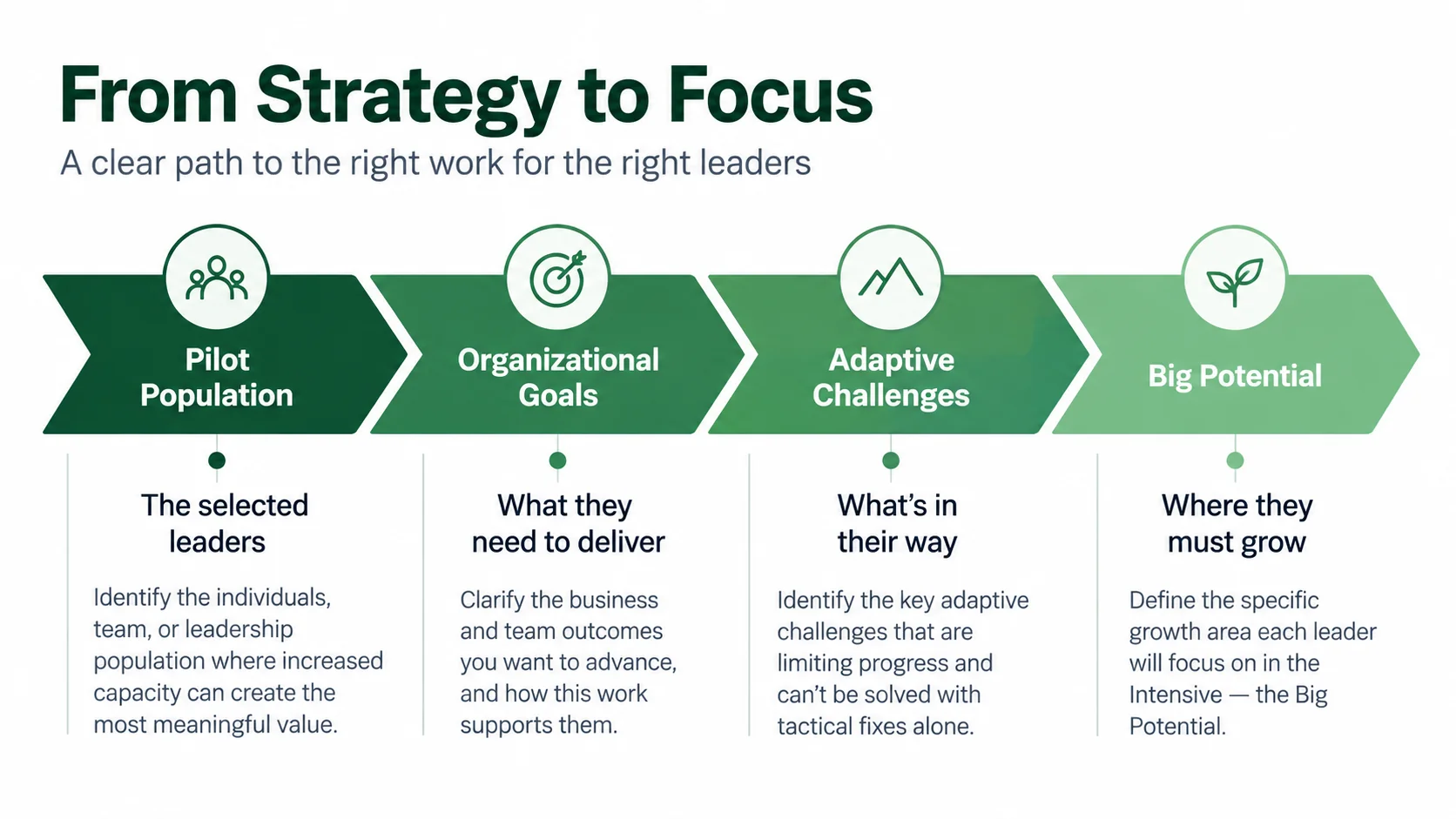
Pilot Population
Strategically select the leaders whose growth is most consequential to your priority business and team objectives. (This is what the questionnaire above is designed to land.)
Brian, a VP in a specialized retail technology business within a larger global payments company, led a four-person commercial leadership team spanning account management, sales, and service.
He selected this team as the pilot population: himself, a Director of Account Management, a Director of Sales, and a VP of Service. Each leader owned a different part of the same highly interdependent commercial operation, making growth within this group consequential both individually and collectively.
Organizational Goals
Each participant identifies the specific organizational and team goals and objectives each is accountable for delivering against, along with the outcomes that would indicate meaningful progress.
Examples:
- Delivering a strategic initiative
- Improving cross-functional execution
- Leading effectively through change
- Making higher-quality or faster decisions
- Improving customer or business outcomes
- Increasing team ownership and accountability
The team’s overarching goals centered on improving commercial execution by increasing team ownership, strengthening the speed and quality of decision-making, and improving on-time delivery against key business priorities.
These outcomes provided the organizational context for determining where each leader most needed to grow
Individual Adaptive Challenges
Identify the number one adaptive challenge limiting each participant’s ability to deliver against those goals, creating a clear line of sight between the business outcome and the underlying capacity constraint.
Examples:
- Fear of speaking up or being more visible
- Avoidance of direct communication or confrontation
- Waiting for perfect clarity before taking action
- Defaulting to urgent and tactical work
- Over-explaining instead of communicating with clarity and authority
Brian self-identified his primary adaptive challenge as “talking too much and solving too much.”
This aligned with feedback he had received in 360s for more than two years. His tendency to dominate conversations and quickly provide solutions was limiting his team’s ability to contribute ideas, work through problems, and take greater ownership
Big Potential
Translate the adaptive challenge into a Big Potential: the capacity growth most likely to unlock meaningful improvement in leadership performance and organizational outcomes.
Examples:
- Confidently articulating value in high-stakes conversations
- Holding others accountable while maintaining strong relationships
- Taking effective, timely action without needing perfect clarity
- Operating as a proactive, strategic leader rather than staying in the tactical
- Communicating with greater clarity, directness, and authority
One important nuance holds this together. The organization sets the strategic frame, including the population and the objectives. Within that frame, each participant initially self-selects the adaptive challenge they will work on. This is deliberate. In a pilot, we want the challenge to be highly relevant to the individual, something they can genuinely feel themselves stuck on and want to move. That relevance is what creates the conditions for them to experience firsthand the value of becoming more aware and growing adaptively.
Self-selection is the starting point, not the limit. Once participants understand the approach and have experienced how adaptive growth works, external feedback can be incorporated and additional adaptive challenges can be identified and addressed. We can tell people where to look, but the first experience is most powerful when they begin in a place that matters deeply to them.
Brian translated his challenge of “talking too much and solving too much,” into his Big Potential:
Creating more space for his team to think, contribute, and own more of the solutions.
The growth was not simply about talking less. It was about increasing the capacity and ownership of the people around him.
The Big Potential is each participant’s focus in the True Leadership Intensive, and the anchor for everything in Step 3.
ROI That’s Built In
Cost, objectives, measures, and value - building ROI into the engagement from the start
Much leadership development is evaluated primarily at the level of participant experience. That makes sense when everyone is being trained on the same competency, but it also makes it difficult to connect what happened in the program to what changed in the work.
The True Leadership Intensive is structured differently. Each participant begins with a specific adaptive challenge that is relevant to them, connects that challenge to a Big Potential and defined organizational objectives, and establishes the basis for measurement before the work begins.
That creates a clear line from the challenge, to the intended growth, to the outcomes that matter, to the value of the movement that occurs.
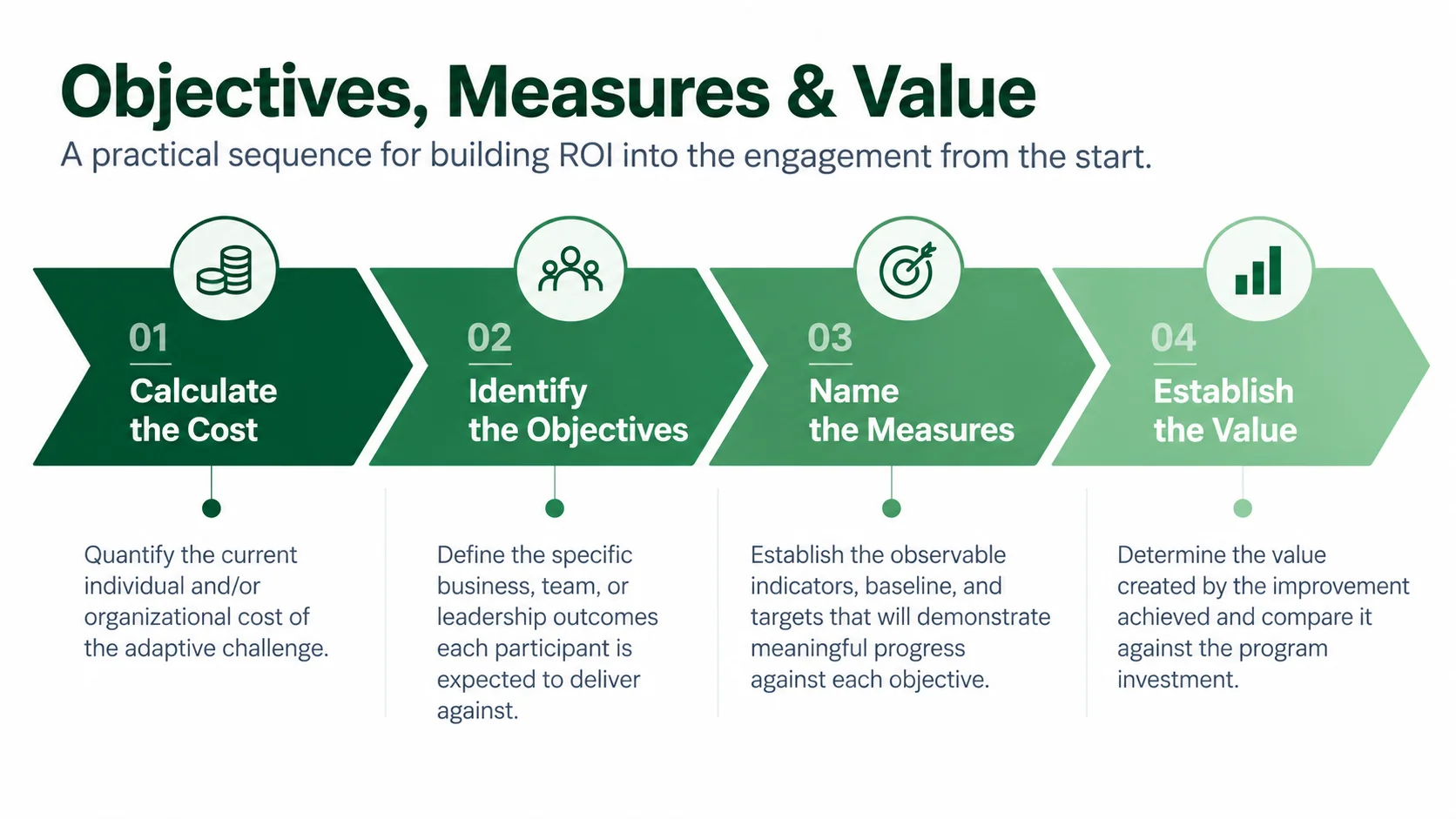
The four steps below are how we do it.
‘You Get What You Measure’
Calculate the Cost of an Adaptive Challenge
We begin by looking at what the adaptive challenge is already costing, both individually and organizationally.
The specificity of the challenge is what makes this possible. Rather than measuring against a broad competency, we can look at the actual impact of one clearly defined challenge: the time it consumes, the decisions or outcomes it delays, the opportunities it limits, and the drag it creates for the people around the leader.
Where a financial estimate can reasonably be made, we make it conservatively. A defensible low estimate is far more useful than an impressive one.
Cost of An Adaptive Challenge Calculator
Give it a try for your own adaptive challenge, with the report sent right to your inbox.
Using our Cost of an Adaptive Challenge Calculator, we estimated the cost of Brian’s pattern using only the time it consumed for him and others in relation to one specific business outcome.
Based on intentionally conservative calculations, the estimated annual cost of this one adaptive challenge was approximately $400,000/year.
That’s one leader, one adaptive challenge, and only one dimension of its organizational impact.
Identify Individual Development Objectives
Having identified a specific Adaptive Challenge and corresponding Big Potential as the focus for the Intensive, we can define the specific development objectives that would represent meaningful growth in that Big Potential.
The objectives describe what would change if the individual leader genuinely makes progress in the area of their Big Potential.
This gives us the next link in the chain:
Organizational Goal → Adaptive Challenge → Big Potential → Development Objectives
Brian’s Big Potential was creating more space for his team to think, contribute, and own more of the solutions.
Meaningful growth would therefore include:
- Speaking less and creating more space for others
- Asking questions before offering answers or solutions
- Allowing team members to work through problems before stepping in
- Increasing ownership of decisions and solutions across the team
- Reducing unnecessary dependence and escalation to him
In simple terms: say less, solve less, empower more.
The organizational objective establishes why the growth matters. The individual development objectives define what that growth would actually look like in practice.
The Measures
With the objectives defined, we establish the observable indicators that will demonstrate meaningful progress, including the relevant baseline and, where appropriate, specific targets.
This is where growth in the area of the Big Potential becomes measurable.These measures can be baselined at the beginning of the engagement and reviewed again as the work progresses.
Quantitative/Objective
- Time recovered
- Efficiency and productivity
- Business outcomes and results
- Sales or customer outcomes
- Retention
Qualitative/Subjective
- Confidence
- Stress and energy
- Leadership presence
- Ownership and accountability
- Team dynamics and culture
This step requires some discipline. Meaningful ROI depends on agreeing in advance about what movement would look like and being willing to measure it. TLI provides a concrete challenge and a defined set of outcomes against which that measurement can occur.
Brian then identified observable measures that could establish a baseline and show whether meaningful movement was occurring.
EXAMPLE: Quantitative/Objective
- How long it takes before he speaks in a meeting
- # of other people that contribute in meetings
- Time spent solving issues that could be owned elsewhere
- Individuals come to him with suggestions and solutions for challenges
- # of decisions made without unnecessary escalation to him as the bottleneck
EXAMPLE: Qualitative/Subjective
- Team members’ sense that they have space to contribute
- Team members’ ownership of problems and solutions
- Team perception of increased autonomy and empowerment
- Brian’s comfort allowing others to work through problems independently
- Observed quality of his listening and inquiry
These measures connect his individual growth back to the broader outcomes the team is responsible for producing.
While some measures will move within the five-week Intensive. Others may require a longer window for sustainable measurement and can be reviewed again at 30, 60, or 90 days.
The Value
Finally, we evaluate what the movement created.
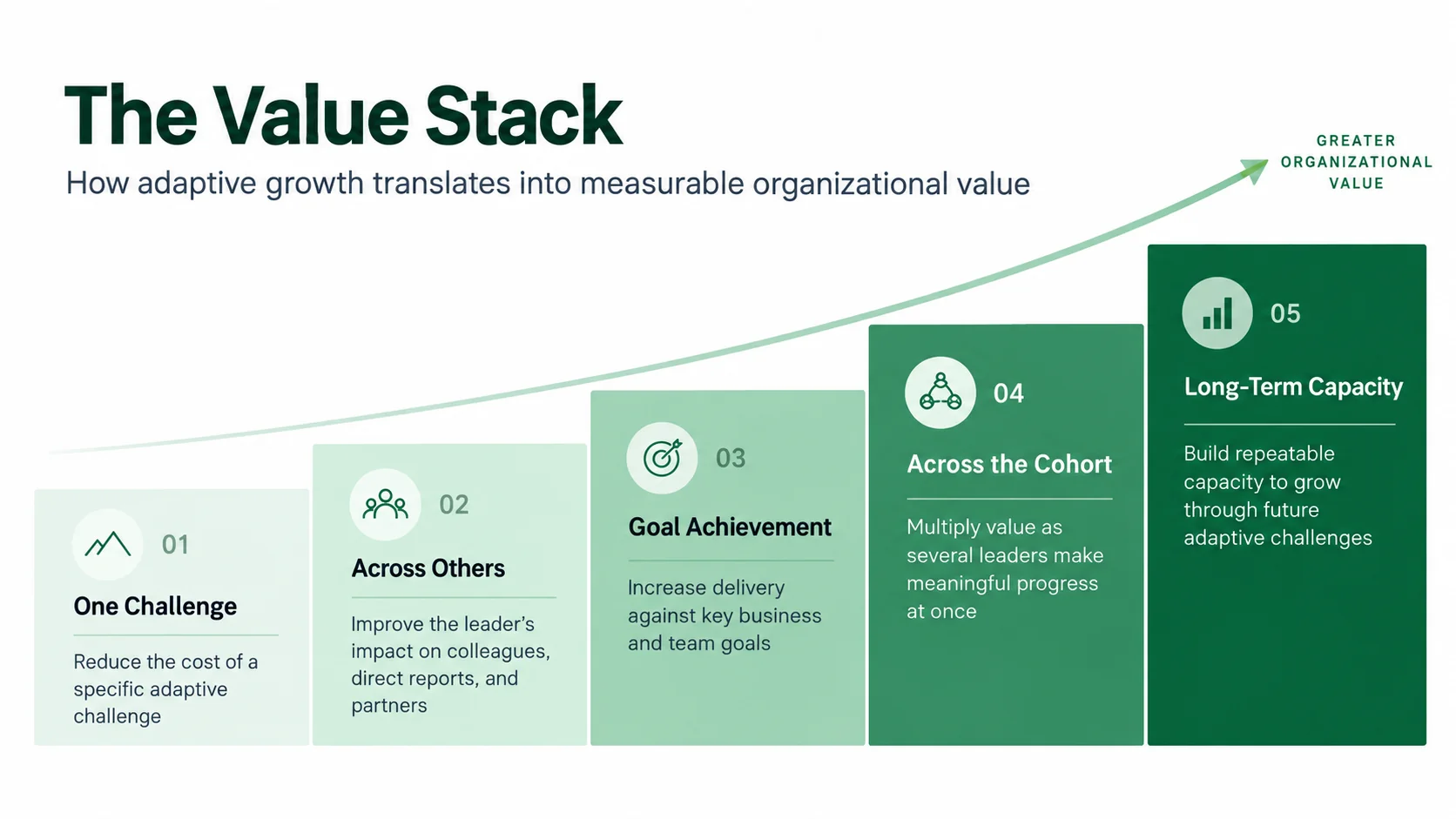
We begin with the clearest, most defensible value connected to the participant’s Big Potential, then look outward. Because adaptive challenges rarely affect only the individual experiencing them, the value of growth tends to spread and compound.
We consider value in layers:
- One person, one challenge: Capture the value created by reducing the cost and impact of the specific adaptive challenge.
- Impact across others: Account for how the leader’s growth improves the effectiveness, ownership, and experience of the people around them.
- Organizational goal achievement: Measure the value created as that growth translates into stronger delivery against the business and team outcomes that matter.
- Across the cohort: Consider the compounding value created when several leaders make meaningful progress at the same time.
- Long-term capacity: Recognize the enduring value of leaders developing the ability to identify and grow through future adaptive challenges.
The deepest return is not simply a leader who performs better. It is a leader who keeps getting better. Where the impact can reasonably be translated into financial value, we calculate it. Where it cannot, we evaluate the relevant operational, behavioral, and organizational outcomes directly.
The goal is not to manufacture an impressive ROI number. It is to understand, as clearly and completely as possible, what changed, what that change made possible, and what it is worth.
The Path Forward
Run the pilot. Review the evidence. Decide what comes next.
Together, we:
- Confirm the pilot population
- Clarify the organizational goals connected to the work
- Establish the relevant measures and baselines
- Prepare participants to identify the Big Potential they will bring into the Intensive
Participants complete an orientation and the Big Potential Workbook before the first session.
The True Leadership Intensive runs for five weeks, with five 90-minute facilitated group sessions.
Each participant works through their own Big Potential and applies what they are discovering directly in their work: in meetings, decisions, relationships, and everyday leadership.
Throughout the pilot, we stay connected to the development objectives and measures established at the outset so that the work remains grounded in observable change.
At the conclusion of the pilot, we partner with you to understand the impact of the work.
We return to the baselines and measures established at the outset and look at:
- Progress against each participant’s Big Potential
- Changes in the behaviors and outcomes being measured
- Impact on the organizational goals connected to the work
- The value that can reasonably be attributed to that movement
- Outcomes that require additional time to evaluate
Where appropriate, we can also establish 30-, 60-, or 90-day follow-up measurement to assess whether changes are sustained and how their impact continues to develop.
We then synthesize what we learned and review it with organizational sponsors, including participant-level insights where appropriate and with participant consent.
The purpose is straightforward: to understand what changed, what it was worth, and what the results suggest should happen next.
The results of the pilot provide the basis for determining whether and where to continue the work.
Depending on what we learn, that may include:
- Additional cohorts with other leadership populations
- Extending a team pilot into work on collective adaptive challenges
- Continued coaching for individual leaders
- Equipping leaders to apply the True Leadership Approach with the people and teams they lead
The appropriate next step is determined by the evidence from the pilot and the organization’s broader leadership priorities.
Where To Next
See what changes when leaders do this work.
Hear from leaders who have been through the five weeks, or put a number on what one adaptive challenge is costing today.